“Sometimes the places we spend our childhood trying to grow beyond become the very places our hearts spend adulthood longing to return to.”
There is a song by Miranda Lambert called The House That Built Me.
I’ve heard it more times than I could possibly count. But no matter how often it plays, something about it reaches a part of me that time has never quite touched.
Maybe it’s the memories.
Maybe it’s the people I’ve lost.
Or maybe it’s because, somewhere deep inside this 37-year-old woman, there’s still a little girl who wishes she could go home.
Not to the home I have today, but to the house where my story began.
What’s almost unbelievable to me is how closely the song resembles pieces of my own childhood.
There’s a part about handprints left in the concrete outside a childhood home.
We had those.
My mother’s, my father’s, and my brother’s handprints were pressed into the concrete. At the time, it was simply a family leaving its mark on a place we called home. I wonder if they knew how much those impressions would one day mean to me.
Not because the concrete itself was special, but because of the hands that touched it—the people they belonged to and the life we were living before any of us knew how much things would change.
There’s another part of the song about a bedroom upstairs and learning to play guitar.
That one gets me, too, because I remember hearing my brother play.
Music has a way of unlocking memories we didn’t know we were still carrying. I don’t remember every conversation or ordinary afternoon in that house, but I remember pieces: a guitar, familiar voices, and the small details I never realized I would miss.
Recently, I found myself looking through old photographs.
One shows the outside of the house where I grew up. Beneath that enormous tree stand my uncle and my mother, with the house behind them.
I studied the windows, the siding, the yard, and the branches stretching over everything. I wasn’t only looking at an old photograph; I was looking at a piece of my life that no longer exists the way I remember it.

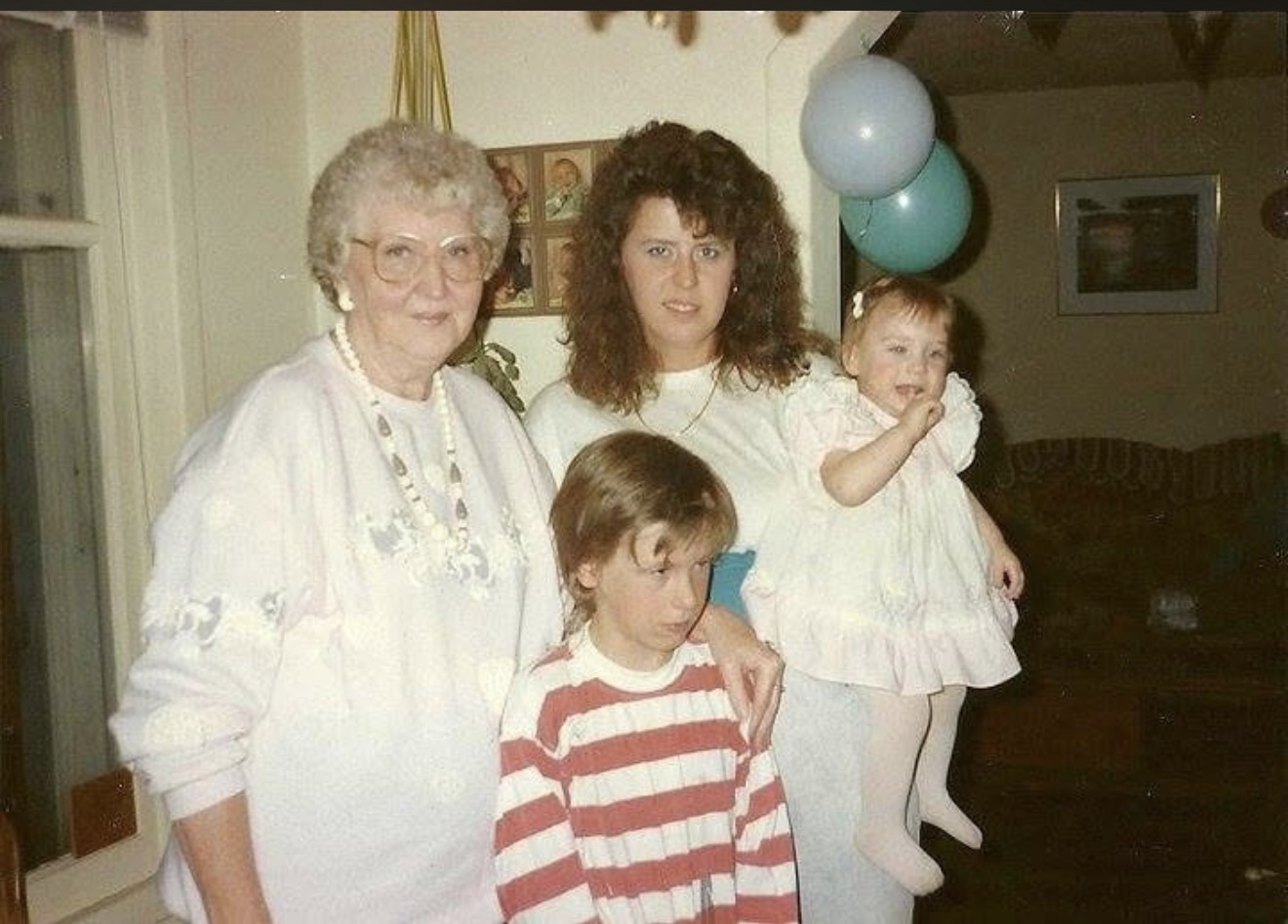
Then I found another picture—one I don’t remember being taken.
There I am, a little girl sitting in a baby walker with my mouth wide open, making what looks like the silliest face. Behind me, my mother leans toward the camera.
It’s a simple photograph: a mother and her daughter inside the house where that little girl’s life was beginning. I don’t remember what my mother said, who held the camera, or what filled the room with sound. But the photograph tells me that moment existed, and that someone thought it was worth saving.

My mother was young once.
My father was young once.
My grandmother was living a life of her own while helping raise me.
Before I understood the complicated parts of being a family, we were simply people sharing a life together.
My childhood wasn’t perfect. There were absences, changes, and circumstances that took years to understand. When my parents’ relationship ended, my father became responsible for raising me. He worked tirelessly to provide for us.
As a little girl, I only knew that my dad worked a lot. I didn’t understand the bills, sacrifices, or exhaustion. I didn’t yet know that sometimes love looks like getting up every morning and going to work because someone is depending on you.
I understand now.
That is what I see when I think about that house—not only walls and windows, but the people who gave them meaning. I remember a time when I didn’t understand how quickly life could change or imagine what it would feel like to lose my father and no longer return to my grandmother’s care.
As children, we don’t realize we’re living inside memories. We simply live, grow, and rush toward the future. Only later do we understand that ordinary moments can become the ones we would give anything to revisit.
Sometimes I wonder what it would be like to stand outside that house again.
Would I recognize everything?
Would it look smaller than I remember?
Would the tree still be standing?
And would those handprints still be there?
I’d want to place my grown hand over the impressions left by my family—not because I believe touching them could bring anyone back, but because small evidence of a person’s existence can become precious after they’re gone.
A photograph.
A familiar song.
A handwritten note.
A handprint in concrete.
Maybe that’s what the song has always meant to me. Not necessarily wanting the house back, but wanting the feeling of belonging to a moment before I understood how temporary everything could be.
Before grief.
Before addiction.
Before heartbreak.
Before motherhood taught me another kind of love and pain.
Before I had to learn how to rebuild my life, I was simply a little girl with a hardworking father, a devoted grandmother, a brother whose guitar I could hear, and a mother whose face appears beside mine in a photograph I don’t remember anyone taking.
That beginning is still part of me.
Growing older teaches you that some questions cannot be postponed forever. One day, the people who could have answered them are no longer here.
At 37, I’m still learning how to carry that absence. Grief isn’t only the day someone dies. Sometimes it is hearing a song and remembering a life you can’t return to, or finding a photograph that preserves a moment your own mind could not keep.
I’ve built a life far away from that childhood house. I’ve become a wife and a mother. I’ve made mistakes, survived losses, and endured seasons I once thought would break me. I’m learning how to live again rather than simply survive.
Still, I can’t separate myself from where I began.
My father’s sacrifices helped shape me.
My grandmother’s love helped shape me.
Even the difficult parts of childhood became part of the woman I am becoming.
And the little girl in that photograph the one sitting in her walker, unaware of the camera or the future waiting for her is still here.
She is in the woman who writes these words, misses her family, and continues trying to understand her own story.
For years, I thought becoming someone new meant leaving old versions of myself behind. Now I’m beginning to understand that becoming can also mean returning: to the memories, the lessons, and the child who existed before life taught her to question her worth.
She mattered before she accomplished anything.
Before she survived anything.
Before she became anyone’s wife or mother.
She mattered simply because she existed.
If I could return to that house for one more day, I wouldn’t try to change the past. I would simply notice it—the rooms, the sounds, the familiar voices, and the people I loved.
Before leaving, I’d stop at the handprints and remember how something so small could hold so much history.
Perhaps that’s what a home really is: not just a building, but the people and moments that leave their impressions on us long after we’ve gone.
Those handprints were pressed into concrete, but the people who made them left their marks on me, too.
I may never return to the house exactly as I remember it, but I can carry its pieces forward—in my writing, in the way I love, and in the woman I’m becoming.
The house may no longer be mine. But the little girl who grew up there will always be a part of me.
And perhaps, after all these years, I’m finally beginning to understand that I don’t have to go home to find her.
She’s been with me all along.